19th of February 2026
CFD in Action: Workshop Supporting the DAEDALUS Rocket Development
MAST (Minho Aerospace Students’ Team), in collaboration with AeroUM & PAS Minho, hosted a hands-on workshop dedicated to Computational Fluid Dynamics (CFD) using ANSYS.
The session began with a short technical introduction delivered by a PhD researcher from FEUP specializing in combustion analysis in rocket engines using CFD. This opening segment provided valuable insight into how numerical simulations are applied to study combustion processes inside propulsion systems, including flow behavior, mixing, and thermal effects. The presentation highlighted the role of CFD in supporting the design and optimization of rocket motors in advanced aerospace research.
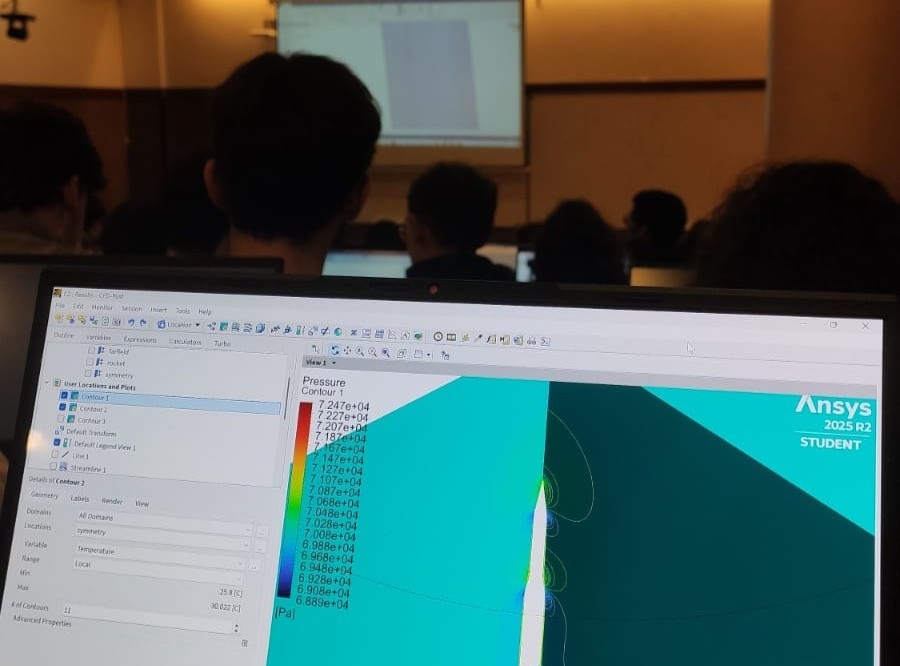
The practical component of the workshop focused on the aerodynamic analysis of a rocket nose cone. Participants worked through the complete CFD workflow in ANSYS, starting with 3D geometry preparation and domain definition. Particular emphasis was placed on the importance of proper geometry construction and the use of influence bodies to refine the mesh in critical flow regions.
Attendees then generated the computational mesh and explored how mesh quality directly impacts simulation accuracy and stability. The session reinforced how crucial meshing strategy is within the CFD process, often playing a decisive role in obtaining reliable results.
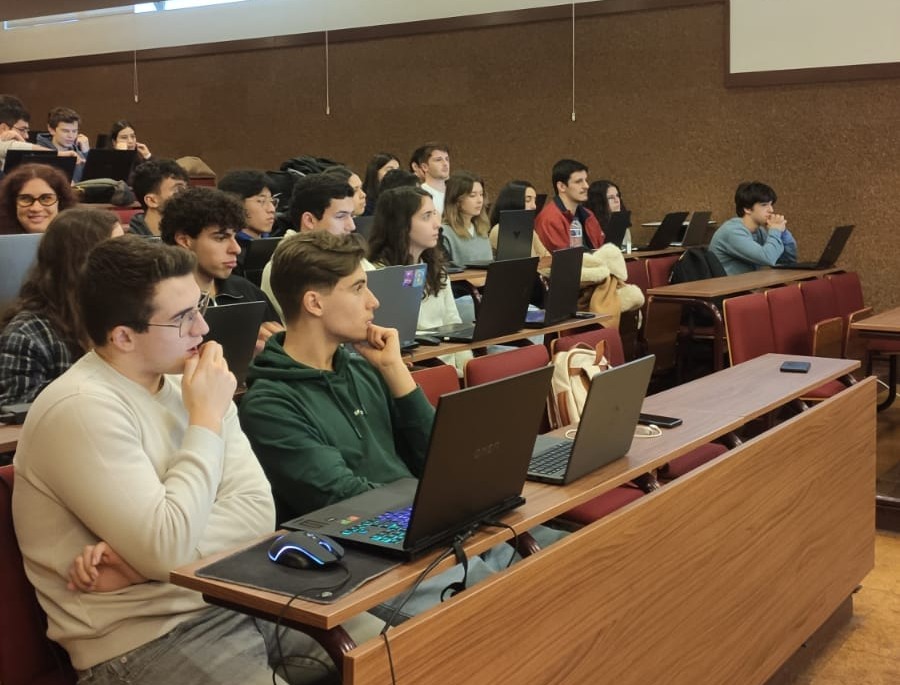
The solver setup itself was shown to be relatively straightforward once the physical problem was properly defined. Boundary conditions were applied, and results such as velocity fields, pressure distribution, and flow behavior around the nose cone were analyzed during post-processing.
Overall, the workshop highlighted a key engineering lesson: while CFD tools can appear complex, a clear understanding of geometry, meshing, and physical modelling principles is what ultimately determines the quality of the simulation. For MAST members, this workshop represents an important step in strengthening the technical foundations required for ongoing and future projects, including the development of student-led rocketry systems, such as the one being currently developed by our DAEDALUS team. CFD plays a crucial role in validating aerodynamic performance before physical testing, reducing iteration time and improving design reliability.
MAST remains committed to providing technically rigorous and practical learning opportunities that bridge academic knowledge with real-world aerospace applications.